
EMDR Therapy
CALIFORNIA AND ONLINE
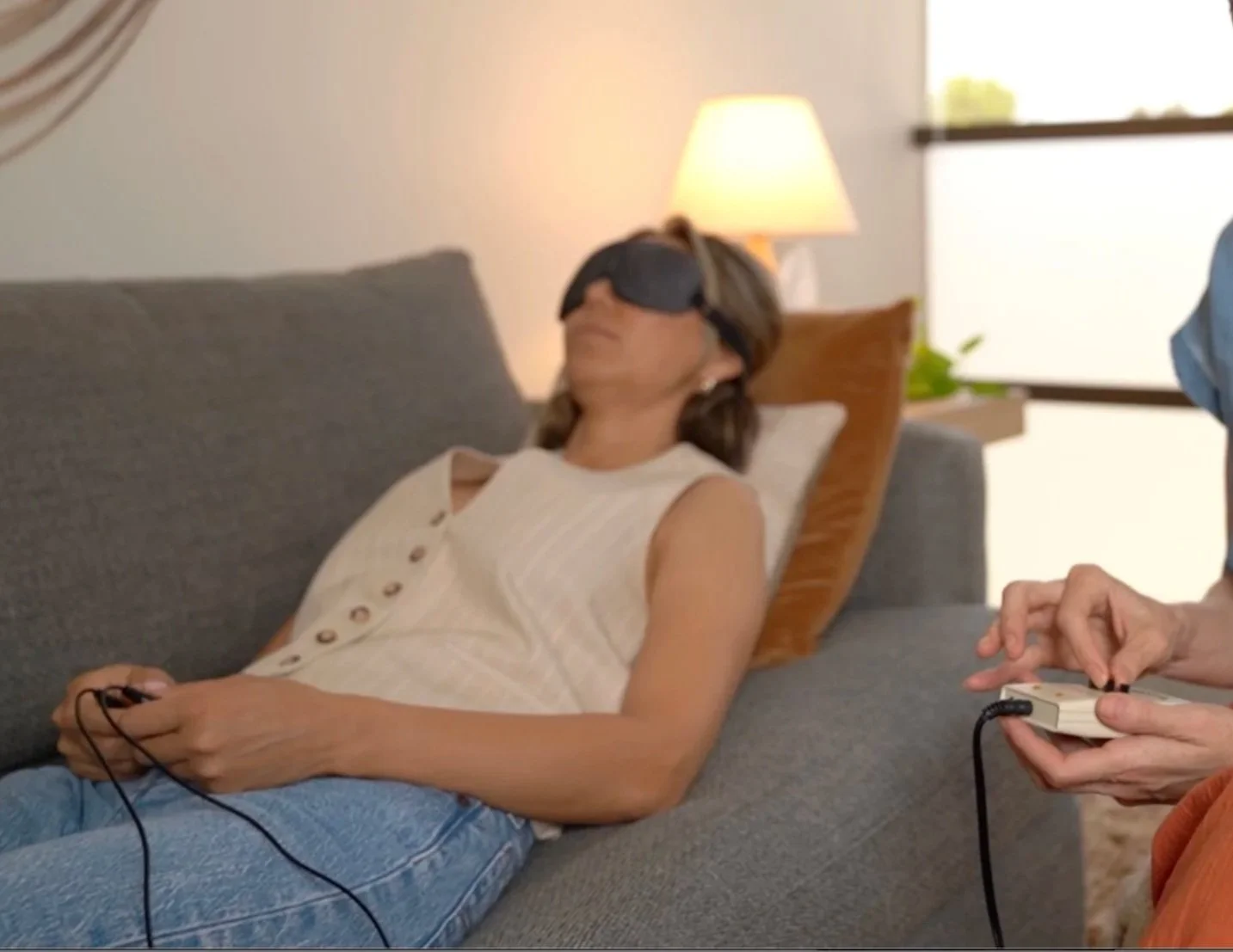
EMDR is a targeted and fast-acting alternative to talk therapy that is scientifically-validated.
EMDR heals anxiety, depression, pain and phobias at the root level by clearing emotional charge and integrating past trauma.
What is EMDR Therapy??
Eye Movement Desensitization and Reprocessing (EMDR) was Founded by Dr. Francine Shapiro in 1987 for trauma and psychological distress. It is a targeted and carefully structured protocol with a strong focus on containment and resourcing. Even though it goes into difficult mental terrain, it can feel safe, affirming and nurturing.
Because of its direct nature, EMDR may require fewer sessions than regular talk therapy.
The distinguishing feature of EMDR is that it uses bilateral stimulation to target and reprocess traumatic memories. Reprocessing a memory means removing its emotional charge so that it becomes a regular memory and is no longer triggering.
Bilateral stimulation can take the form of physical stimulation on either side of the body, through electronic tappers, hand-tapping or lateral eye movements.
EMDR has been shown to be an effective treatment for anxiety, depression, phobias, chronic pain, grief, and other stress-related conditions.
EMDR helps people who feel

Anxious, overwhelmed or hyper-vigilant
Trapped by racing, incessant thinking
Stuck, shut down or hopeless
Stuck in grief or unable to grieve
Reacting or avoiding in relationships
Obsessing or hung-up over something or someone
Body symptoms like IBS, migraines, back pain & autoimmune disorders
EMDR is effective in-person and online
Our EMDR therapists
-
![]()
Justin Baker
PSYCHOTHERAPIST
Somatic, Hakomi, IFS, Highly Sensitive Person
San Jose, Online -
![]()
Megan McAllister
PSYCHOTHERAPIST ASSOCIATE
Somatic,
Attachment-Focused EMDRSanta Monica, Online
-
![]()
Natalie Baker
PSYCHOTHERAPIST
Somatic, EMDR, IFS, Parenting, Health & Survivorship
Beverly Hills, Sawtelle, Online
-
![]()
Stephanie Rotuno
PSYCHOTHERAPIST
Somatic, EMDR, IFS, Brainspotting, Highly Sensitive Person, Therapy Dog
Santa Monica, Online
-
![]()
Ulika Scout
PSYCHOTHERAPIST ASSOCIATE
Somatic, EMDR, Parts-Informed Psychotherapy
San Francisco, Online
-
![]()
Angie Bradshaw
PSYCHOTHERAPIST, FOUNDER
Somatic, EMDR, IFS, CPTSD, Highly Sensitive People
Brentwood, Online
-
![]()
Steven Bradshaw
PSYCHOTHERAPIST, FOUNDER
Somatic, EMDR, IFS,
Founder CoachingBrentwood, Online




Stages of EMDR
The full EMDR process involves a structured approach that typically takes place over 5 to 15 sessions.
History-taking and Treatment Planning: Comprehensive assessment to tailor treatment.
Preparation: Establishing a safe therapeutic alliance.
Assessment: Identification of traumatic memories, negative beliefs, and emotional and somatic symptoms.
Desensitization: Reprocessing of traumatic memories through sets of bilateral stimulation.
Installation: Replacing negative cognitions with positive beliefs that surface from the unconscious.
Body Scan: Identifying and addressing any residual emotional and somatic tensions.
Closure: Restoring equilibrium within the session and containing unresolved issues for further work.
Reevaluation: Ongoing assessment of therapeutic outcomes and testing of the work performed.

What actually happens in an EMDR session?
After the initial phases of history-taking and preparation, the client and therapist work together to target specific traumatic memories.
The therapist helps the client to identify the worst part of the incident, including any current emotional and body-based responses, and any negative self-beliefs that associate to the incident.
Once the target is set up, the therapist employs sets of bilateral stimulation, or physical stimulation on either side of the body, while the client allows a stream of experiences or free associations to take place. After each set, the client reports back their experience and the therapist may instruct them to continue on in this direction. Alternatively, if the client appears to stuck or looping, the therapist may provide an interweave, which is a socratic question designed to bring in information that is known to the client, but not accessible in the current state.
Nowadays, bilateral stimulation is most commonly effected by either electronic tappers, which are small handheld devices that produce alternating pulses of tactile stimulus, or tapping performed by the therapist or client.
In the early days, EMDR was mostly performed with lateral eye movements with the client following the therapists outstretched finger from side to side. However, this was found to be tiring for both client and clinician and required the client’s eyes to be open. The current preferred method of tapping allows for the client’s eyes to be closed which enables powerful and spontaneous visualizations to occur that support the healing process.
When an EMDR session goes well, the client discharges bound survival energy and the traumatic memory loses its charge. The client often achieves a state of flow, creativity and embodied imagination, where new possibilities can unfold. As this takes place, it is common for clients to experience states of joy, euphoria and optimism that have long been absent.
Example EMDR session
Example EMDR Session
Prince Harry on EMDR
Prince Harry opens up about EMDR Therapy
New York Times on EMDR

“Our brains do not have the capacity to completely focus on both the bilateral stimulation and the traumatic memory, Dr. Houben said. The theory behind E.M.D.R. is that memories become less vivid and emotional when a patient can’t focus on them completely.
“At the end of a therapy session, you put it back in storage,” Dr. McNally said. “It’s in a degraded form. It’s not quite as emotionally evocative.”
-New York Times, 9/20/2022
FAQs
-
EMDR sessions are very focused on a presenting issue. Sessions feel like a guided meditation that explores both the resourced, or positive aspects of your experience and the challenging or darker aspects of your experience. We trace these latter back to traumatic events that have not been resolved yet and we work to complete and integrate these into daylight consciousness.
The distinguishing feature of EMDR is that it uses bilateral stimulation to reprocess traumatic memories. Bilateral stimulation can take the form of physical stimulation on either side of the body, through hand tapping or electronic tappers, or lateral eye movements.
We usually provide a mix of both talk therapy and EMDR and find that they complement and support each other. Often the talk therapy contextualizes and maps out your situation and allows you to feel deeply understood. Then at the right point, somatic work helps to shift and transform your nervous system to reach a new more vital, secure, and resilient equilibrium. This transformation in turn feeds back into talk therapy, where new insights and new meanings emerge.
Book a free consult, and we can discuss your situation.
-
Yes! See the section below titled “Scientific Support for EMDR.”
And here is a metastudy of the research on EMDR.
"Twenty-four randomized controlled trials support the positive effects of EMDR therapy in the treatment of emotional trauma and other adverse life experiences relevant to clinical practice. Seven of 10 studies reported EMDR therapy to be more rapid and/or more effective than trauma-focused cognitive behavioral therapy. Twelve randomized studies of the eye movement component noted rapid decreases in negative emotions and/or vividness of disturbing images, with an additional 8 reporting a variety of other memory effects. Numerous other evaluations document that EMDR therapy provides relief from a variety of somatic complaints."
-
Sometimes we just need a little nudge to get onto a better track and we're not that far off coping a lot better and flowing with life. In that case, 6 - 12 sessions may be enough to gain a new piece of insight, have a different experience, and apply this to living in a different way and shifting things onto a better track. Often in these cases, clients find therapy so helpful and enjoyable that they continue even after they've resolved what they came for.
Other times, due to life adversity, we have become very set in our ways and our personality structure now blocks what we desire most (love, success, happiness, etc). In these cases we may need to work from 6 months to several years to make a fundamental shift in order to turn things around. In these cases, the work usually takes longer than we would like, but the change is more significant than we anticipate. The benefits from long term work reach into every area of life and compound over the years that follow.
Book a free consult, and we can discuss your situation
-
EMDR in-person is a very rich experience, given the greater amount of information available and the increased potential for somatic resonance and micro-attunements.
That said, a surprising amount is conveyed through the screen. Bilateral Stimulation can be provided by self-tapping or purchasing electronic tappers to use at home (around $120).
We have seen many telehealth somatic sessions get to a deeply transformational space. Virtual sessions are also more convenient and it's easier to maintain a weekly rhythm, which counts for a lot. We do like it when virtual clients are able to come in occasionally for an in-person session. The connection seems to carry over to on-screen work. We would say try whatever works best for your schedule and see how you find it.
You're welcome to call and do a free consultation to discuss your situation.
-
Some part of you must disagree or you wouldn't be here reading about therapy! That part just needs more support. We become the champion of that part of you that wants things to be a lot better. We've seen many times how getting into the rhythm of therapy and putting an action-reflection loop into place is absolutely transformational. Perhaps the conditions have not been conducive until now. Perhaps the voices of doubt and judgment have just been a little too strong. Perhaps everything you've done up to this point can become the foundation and launchpad for finally breaking through. There's only one way to find out.
Book a free consult, and we can discuss your situation. There is no ongoing commitment and we'll be honest about what we think could be possible for you.
-
We offer a range of fees based on clinician and modality. You can see our fee ranges here. Our fees are competitive against many private practices in California, particularly for somatic offerings. Many of our clinicians have a few sliding scale spots that can lower the fee somewhat in cases of financial need.
If you need a substantially reduced fee, we can recommend low-fee training clinics such as Maple Counseling Center, Antioch University Counseling Center, Southern California Counseling Center, Valley Community Counseling Clinic, Airport Marina Counseling Center, or Counseling West. These can be great options to get started. The main issue tends to be therapist turnover, as therapists complete their training and move into private practice. There is also a high variance between therapists, so you may need to go through several before you find a good fit and then you may lose them after several months. There can also be long waitlists depending on the time of year.
If you would like to discuss your situation and what you can afford at this time, please schedule a free consultation.
-
Yes, we accept insurance as an out-of-network provider for all PPO plans, including: Anthem Blue Cross, Blue Shield, Blue Card, HealthNet, United Healthcare, Cigna, Optum, Magellan, Value Plus and many others, depending on your coverage. We are not in-network or included within HMO plans for any providers.
With PPO, you pay the full fee upfront and your insurance company reimburses you directly.
Beyond can call your insurance on your behalf in order to find out what your coverage would be.
If you schedule a free consult, we can discuss how this would work and any other questions you have about insurance.
-
We have a matching process where you first do a free consultation with an intake coordinator. The coordinator listens to your story, provides some information, and helps to select the best therapist for you. You then get another free consultation with the therapist you select.
Match is based on personality, location, in person or virtual and the approach best suited to your issue. All of our therapists have a foundation in somatic and depth psychologies. Likely you will connect with one more than the others.
We look forward to hearing from you. Book a free consultation now!
Is EMDR effective online?
Many studies have found online EMDR to be effective which matches our own experiences with clients.
Remote EMDR therapy: A service evaluation of therapist and client experiences—BMC Psychiatry (2024)
A service evaluation of EMDR therapy delivered remotely—Frontiers in Psychology (2021)
Effectiveness of Online EMDR Recent Traumatic Episode Protocol (R-TEP) During COVID-19—Frontiers in Psychology (2022)
Remote EMDR therapy: A systematic review—Journal of EMDR Practice and Research (2024)
You can see a more detailed listing and description of the evidence here.
Hear what clients are saying
-
![]()
Christina, Data Analyst, San Francisco
“From our first session I felt that we uncovered the root of my issues and that I was in good hands. Over the next year, I transformed completely. I went from having chronic pain that prevented me from continuing my career, to now entering that career path again. Look no further!”
-
![]()
David, Somatic Therapist, Kent
“My coach is a highly attuned listener, and processor. The way he holds 'space' is a splendid mix of wisdom, learning, guiding (to the outer edges of the comfort zone, and a little beyond) and support. He helps to shift my awareness and perspective in the most profound way. “
-
![]()
Declan, Software Engineer, London
“I've made actual progress rather than being stuck. Sor far, it’s the only therapist or coach I've had who's been able to talk about literature and art and all of the beautiful things that make up this world in a way that feels genuine. Our work has been very iterative and incremental. I got something in every session.”
-
![]()
Devon, Jewelry Designer, San Francisco
“My therapist is very open and very kind. He's really perceptive and good at listening and honoring where a person is at or what they're feeling and what they might need in that moment. He makes people feel comfortable and safe and fosters a space that felt open and comfortable.”
-
![]()
Faisal, Incoming MD Candidate, DC
“My therapist was instrumental to my growth and coming of age in college, and he has continued to follow-up with me ever since. This is not a business for him. This is his life's calling, and you can feel it. Our sessions have been transformative and lasting.“
-
![]()
Jacob, Scientist, Boston
“I found my coach engaging and curious. He's very unique and he's up to something, I think good! I feel less isolated and more heart-open and connected. I can really see myself in others. I am more in tune now, not just with people but also with animals and trees.”
-
![]()
James, Creative Director, Grand Rapids
“I'm better equipped to handle circumstances and better see how things work. Techniques are sticking. If you look at my brain before we started the work and now, I think there are some new neural pathways, and others that are less entrenched. Our relationship has made a big difference in my life.“
-
![]()
Jorge, Psychology Student, LA
“I met my therapist on a whim at one of the lowest points of my life and have since reached heights of peace, stability and self-advocacy I didn't think possible. Through Beyond, I’ve changed in resounding and permanent ways. I'm ever grateful and can't recommend the care I've received enough.”
-
![]()
Joshua Horsley, Podcaster, Reno
“Beyond has made a huge impact in my life. I instantly connected with my coach and I look forward to our weekly sessions. Now, when I’m stuck or ruminating I often think “what would my coach say to me?” and it really helps me tackle problems on my own. Highly, highly, recommend Beyond!”
-
![]()
Kim, London
“I find my coach to be a really calming and non-judgmental presence. He is very present for you when you're in a session, which I think is really important. I found it really useful and enriching to have more frameworks with which to understand myself and other people.”
-
![]()
Kirby, Meditation Teacher, Vancouver
“Beyond is doing such significant and special work in the world that it is difficult to tame into words. My coach has the rare ability to walk with you down the darker trails of your psyche with warmth. He holds safe and generous space. Thank you, thank you, thank you!”
-
![]()
Kris, Documentary Filmmaker, LA
“I’m a huge fan of Steven and the team at Beyond Psychology! I had a super illuminating and impactful experience. It helped unlock some personal insights and healing that had otherwise been hard to access. I would definitely recommend working with them, and personally hope to do so again in the future!”
-
![]()
Kuljit, Leadership Coach, DC
“I’ll be bold and say the modalities don’t matter as much as my coach’s presence. His calm and connected way of being facilitated my awareness and processing. It amplified my sense of safety and served as a mirror to reflect what was emerging within me. This allowed me to be more embodied in my experiences, which was the next step in my healing journey.”
-
![]()
Kyle, Actor, Bay Area
“My therapist at Beyond is amazing, it’s been really easy for me to talk out my thoughts and have assistance whenever I’ve been in a rough patch or whenever I’ve just been unsure of what to do or what steps to take with a situation. He is also very fun to talk to and very funny!”
-
![]()
Lisa, Psychologist and Researcher, Gothenburg
“My coach at Beyond is genuinely sincere and perceptive, and his deep passion for healing work is palpable. From our very first encounter, I sensed his non-judgmental nature. I wholeheartedly recommend working with him, as it has been an immensely positive experience.”
-
![]()
Osiris, Yoga Therapist, LA
“I feel like I've made real progress in my healing journey. I'm so grateful to have found someone like my Beyond coach. I highly recommend Beyond to anyone who is struggling with stress, anxiety, or other nervous system issues. Thank you for all that you do!”
-
![]()
Paula, Ocean Scientist, Honolulu
“My Beyond coach is deeply knowledgeable and passionate. His holistic and creative approach resonated with me and not only opened new ways of understanding, seeing and experiencing myself but also sparked my own creativity. I could relax into myself and feel connection with others without feeling judged.“
-
![]()
Raquel, Personal Assistant, LA
“I had such a sense of holding, safety and support that let me feel comfortable, seen and held.. My words for him are: safe, connecting, caring, and understanding. I feel grateful now and that I'm still growing and discovering different parts of me. I now have some real tools in case I hit potholes out in the world.”
-
![]()
Tom, Senior Product Manager, London
“My coach is really friendly and creates an open environment where it’s really easy to talk. I'm super grateful for all the work that I’ve done with him and can’t rate him highly enough. I definitely could not be where I am now without him. Thank you!”








The Beyond approach
Many Beyond practitioners are trained in EMDR and use it frequently as a preferred protocol. We can provide in-person services throughout Los Angeles or online services worldwide.
Several practitioners are trained in Attachment-Focused EMDR which is a version of EMDR that focuses on building safety and tailoring treatment to each client’s needs.
We will guide you safely through the process of EMDR and help you to integrate the work into your daily life.
Embark on your healing journey
Contact us today. We can answer your questions and support you as you take your first steps toward a more balanced and vibrant life.